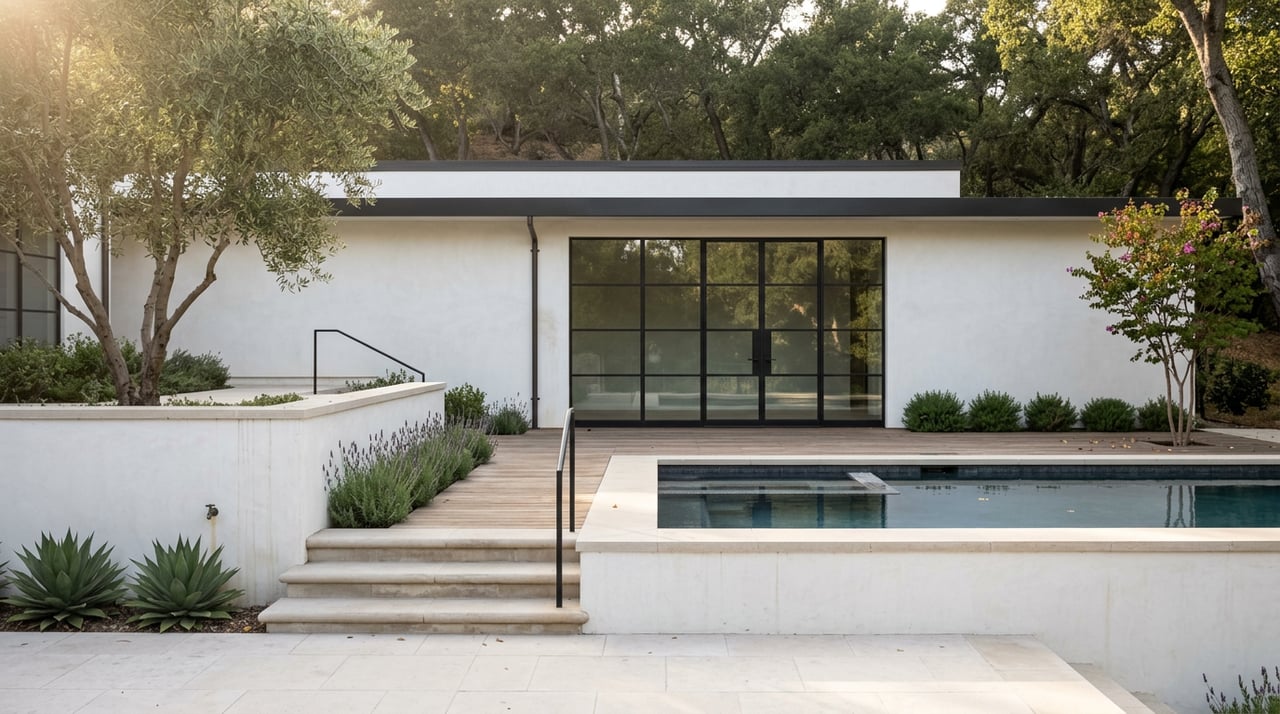
Summerland vs Carpinteria Home Prices: What Shapes Them
September 3, 2026
September 3, 2026
Drive south out of Santa Barbara on Highway 101 and you pass from Summerland into Carpinteria without the coastline ever really changing character. Same freeway, same marine layer burning off by mid-morning. Pull up the two towns' recent sale prices side by side, though, and you'd think you were looking at different planets.
In the three months ending June 2026, Summerland's median sale price hit $6.8 million, up 278.3 percent from the same period a year earlier. Carpinteria, over the three months ending May 2026, posted a median of $1.1 million, up a comparatively modest 29 percent. Read those two numbers next to each other and the obvious story writes itself: Summerland is pulling away as the ultra-luxury outlier, Carpinteria is the accessible cousin next door.
That story is mostly wrong, or at least badly incomplete. The gap says less about which town is more desirable and more about how differently these two markets generate a number in the first place.
Start with volume. Summerland closed just 5 home sales in June 2026, up from 3 the year before. Carpinteria closed 39 in May 2026, up from 19. A market moving 5 transactions a month doesn't have a median so much as it has a rounding error dressed up as a statistic. One oceanfront estate closing instead of a modest cottage can swing the reported median by seven figures without a single buyer or seller changing their behavior. Carpinteria's 39 closings give its 29 percent increase real weight. It reflects a market with enough transactions that no single sale can hijack the average.
Price per square foot tells a similar story if you don't look closely enough. Summerland's median came in at $1,190 per square foot, up 14.1 percent year over year, against Carpinteria's $779, up 3 percent. That $400-plus gap is real. What it isn't is a clean measure of "how much more Summerland costs," because the square footage in that calculation sits on wildly different kinds of land depending on which street you're standing on, which is the part portal comparisons never explain.
Summerland's lot pattern traces back to 1888, when real estate speculator and spiritualist H.L. Williams subdivided his hillside tract into parcels as small as 25 by 50 feet and sold them to fellow believers who wanted a foothold on the coast. Those postage-stamp lots still exist, tucked between homes on much larger, later-assembled parcels that climb the same hillside toward ocean and Channel Islands views.
Santa Barbara County's current zoning reflects that split heritage. Standard residential lots in the area range from 7,000 to 30,000 square feet, and the Summerland Plan carves out its own rule requiring a 10,000-square-foot minimum net lot area for certain two-family dwellings in the 10-R-2 zone. In practice, that means a $1.19K-per-square-foot median can be built from a tiny historic Craftsman on an original spiritualist-era parcel closing the same month as a newly assembled hillside estate three lots wide. Average those two sales and you get a number that describes neither property honestly.
Carpinteria, immediately south, was platted on flatter ground in a more conventional grid. Its inventory is more uniform lot to lot, which is a real part of why its per-square-foot figure moves in smaller, steadier increments year over year. The towns aren't just different in price. They're different in how comparable one sale is to the next, and that difference is baked into the land itself, not the market cycle.
| Summerland | Carpinteria | |
|---|---|---|
| Median sale price | $6.8M (3 mo. ending June 2026) | $1.1M (3 mo. ending May 2026) |
| Median $/sq ft | $1,190, +14.1% YoY | $779, +3.0% YoY |
| Homes sold (latest month) | 5, up from 3 | 39, up from 19 |
| Average days on market | 45, down from 87 | 31, down from 35 |
There's a third factor working on Summerland's numbers right now, and it's newer than either of the ones above.
Highway 101 and the railroad physically split Summerland decades ago, leaving most residences north of the freeway and the town's main beach access, Lookout Park and the path down to Summerland Beach, sitting south of it. For years the two halves were stitched together by a single narrow passage, the Evans Avenue undercrossing, while homes closest to the freeway carried an informal noise discount that showed up in how agents and appraisers priced comps.
That calculus just shifted. Caltrans and the Santa Barbara County Association of Governments recently completed the Padaro and Summerland segments of the Highway 101: Carpinteria to Santa Barbara widening project, adding seven miles of new carpool lanes, six new bridges, sixteen rebuilt on- and off-ramps, and six new sound walls. At the Sheffield Drive Interchange, new freeway bridges replaced the old sub-standard left-hand ramps that used to back up traffic over Ortega Hill. At Evans Avenue, a new bridge in the highway's median made room for a wider freeway along with pedestrian, bike lane, and lighting upgrades underneath. Two of the new sound walls were built with clear view panels specifically to preserve ocean sightlines rather than block them.
Caltrans District 5 Director Scott Eades called the finished work "a community building community" at the ribbon cutting. As of the Santa Barbara Independent's March 2026 update on the broader corridor project, the Summerland section is finished and landscaped, currently in its plant establishment period, while the segments further north through Montecito and along Coast Village Road are still under active construction and not expected to wrap until late 2026 or 2028.
That timeline matters for anyone reading a comp from three or four years ago. A Summerland sale that closed while Sheffield Drive still had left-hand on-ramps and no sound walls was priced against a different noise and safety profile than a home selling today. If a buyer or seller is anchoring on a past sale to justify a number in 2026, it's worth asking whether that sale predates the finished freeway work, because the discount that used to travel with freeway proximity is shrinking in ways the older data can't reflect.
None of this means Summerland is overpriced or Carpinteria is underpriced. It means the shortcut of comparing two portal medians skips the work that actually determines what a given property is worth.
If you're pricing a Summerland listing or evaluating an offer, ask for a rolling twelve-month sales history rather than the last month or quarter alone. Five sales a month is too thin a sample to trust in isolation, but a year's worth of closings starts to smooth out the noise. Ask how the subject lot's dimensions and zoning classification compare to the comps being used, not just the listed square footage, since a 25-by-50-foot historic parcel and an assembled hillside lot three times that size shouldn't be measured with the same per-square-foot yardstick. And check the closing date on any comp against the Highway 101 project timeline. A pre-completion sale near Sheffield Drive or Evans Avenue is telling you about a freeway corridor that no longer exists in its old form.
Carpinteria's deeper sales volume makes its numbers easier to trust at face value, but the same discipline applies. A median built from 39 sales still mixes very different housing stock, from modest inland lots to oceanfront parcels, and averaging across that mix flattens real differences a buyer needs to see.
Does Summerland's higher median mean it's simply the more expensive town to buy into? Directionally, yes, Summerland's land and construction command a premium tied to its hillside views and small, tightly held inventory. But the specific median in any given month says more about which handful of homes happened to close than about the going rate for a typical Summerland property.
Should I trust an older Summerland or Carpinteria comp? Treat it carefully. Check whether it closed before or after the Highway 101 Padaro and Summerland segments were finished, since the noise and access profile near the freeway has changed, and an older sale may be pricing in a discount that no longer fully applies.
Why does Carpinteria have so many more monthly sales than Summerland? Summerland is a small, largely built-out unincorporated community with a limited number of parcels overall, so turnover is naturally low in any given month. Carpinteria has a larger, more varied housing stock across flatter terrain, which produces steadier month-to-month sales volume.
Numbers like these are exactly where a second set of eyes earns its keep. If you're weighing a move between Summerland and Carpinteria, or trying to figure out what a specific lot is actually worth once you account for its size, zoning, and distance from the freeway work, Caleb Overton can walk through the real comps with you. Request a Complimentary Home Valuation to get a read on where your property or your target purchase actually stands.
Stay up to date on the latest real estate trends.

Etiam non quam lacus suspendisse faucibus interdum. Orci ac auctor augue mauris augue neque. Bibendum at varius vel pharetra. Viverra orci sagittis eu volutpat.