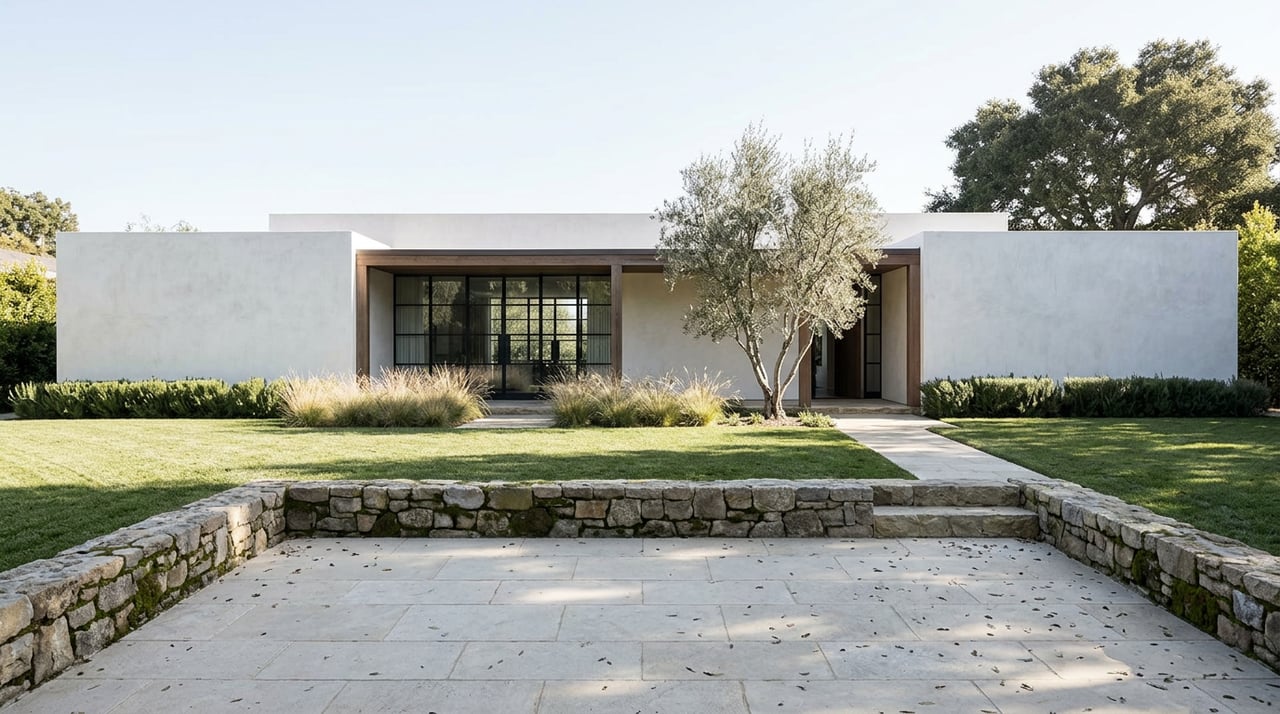
Hope Ranch Has Two Building Departments. Only One of Them Belongs to the County.
September 24, 2026
September 24, 2026
How long does a renovation actually take once you close on a home in Hope Ranch? Most buyers answer that question using math from somewhere else. They think about a county permit desk, a plan check, an inspector's schedule, the kind of timeline a contractor quotes in any Santa Barbara neighborhood. That math is missing a step, and it's the step that decides everything else.
Hope Ranch is unincorporated, so Santa Barbara County handles land use and permitting the way it does anywhere outside city limits. But before the county ever opens a file, the Hope Ranch Park Homes Association runs its own building department, with its own review board, its own fee schedule, and its own annual report on how the year went. That board is called the Architectural Board of Review, or the ABR, and it is not a rubber stamp on the way to a county permit. It is a separate approval with its own odds of failure, and those odds are worse than most buyers expect.
The association's own building department issued 162 total building permits in 2023, and roughly 30 percent of those traced back to ABR or Board of Directors approvals, according to the Hope Ranch Park Homes Association's 2023 Master Building Report. That is not a committee that meets occasionally to bless a paint color. It is functioning infrastructure, processing a meaningful share of the construction activity inside the community's boundary every year, independent of whatever the county is doing on the same project.
That distinction matters because it changes what "getting a permit" means here. In most Santa Barbara neighborhoods, a permit is one conversation with one agency. In Hope Ranch, it is two conversations with two agencies that don't run on the same clock, and the private one generally has to close before the public one opens.
Here is the figure that should change how a buyer plans a renovation budget and schedule: only about a third of Final Review submissions were approved in 2023, per the same association report. Two out of three projects that reached the formal review stage did not clear it on the first attempt.
That is not a rare outcome. It is close to the median outcome. A buyer who assumes their architect's plans will sail through on the first submission is planning around the exception, not the rule.
The association's own building department seems to know this. Its 2023 report describes a Pre-Conceptual Review step as beneficial to applicants, neighbors, and the ABR members themselves, which reads as the department's own acknowledgment that the informal first look is doing real work to keep the formal rejection rate from being even higher. Treating that pre-conceptual step as optional is treating the safety net as a formality, and the data says otherwise.
The dollar amounts attached to ABR review are small relative to a Hope Ranch renovation budget, but the fee structure itself is a useful map of what the board actually cares about. New construction is billed at a base rate for the first stretch of square footage and a per-square-foot rate beyond that, up to the property's floor-area ratio limit. A pool, a fence, a solar installation, and a gate each carry their own modest flat fee, according to the association's published building guidelines.
| Project type | Typical ABR fee |
|---|---|
| New construction | Base fee for first 300 sq ft, then per-square-foot rate to FAR limit |
| Swimming pool | Flat fee |
| Fence | Flat fee |
| Solar installation | Flat fee |
| Gate | Flat fee |
| Re-roof with identical Class A material | No fee, no review required |
That last line is the interesting one. Re-roofing with Class A material identical, including color, to what is being replaced is not considered an alteration under the association's building guidelines, so it requires neither approval nor a fee. Everything else on the list, no matter how routine it feels to a homeowner, triggers a review. The board isn't pricing risk. It's drawing a line between maintenance that preserves what a house already looks like and any change that alters it, even slightly, and it reviews the second category regardless of scope.
Height limits inside Hope Ranch mostly track the same 25-foot cap, but the source of that cap isn't uniform across the community. The association's building guidelines set a 25-foot maximum within the Coastal Zone as mapped by the county, and separately set a 25-foot maximum specifically within the Laguna Blanca Heights portion of Hope Ranch, an area governed by its own recorded declaration layered on top of the general association guidelines.
The practical upshot for a buyer: two lots that look identically capped on paper can be capped by two different documents, and the specific covenant attached to your parcel is the one that controls if a dispute ever comes up. This is a detail that only surfaces when someone pulls the actual recorded documents for a specific address, not when they read a general neighborhood summary.
A renovation calendar can clear the ABR and the county permit desk on schedule and still get reset by something that has nothing to do with either agency: the wastewater system under the house.
Many Hope Ranch parcels are served by mutual water companies rather than a municipal utility, and a meaningful share of the community's larger and older lots run on septic rather than sewer. Septic systems in Santa Barbara County fall under the county's Local Agency Management Program, the local framework the state approved for regulating onsite wastewater treatment. The complication for renovation buyers is that most existing septic systems predate the current version of that program's standards, according to Santa Barbara city planning documentation on septic-to-sewer conversions. A renovation that adds bedrooms or bathrooms increases the modeled flow through the system, and if that triggers a review, the fix is not a quick repair. It is a system brought up to current standards, on a permitting track that runs through the county's environmental health division and is separate from both the ABR and the standard building permit.
None of that shows up in a listing description. It shows up during due diligence, or worse, after the ABR has already approved a design that then has to be revisited once the septic engineer weighs in.
The honest version of a Hope Ranch renovation schedule starts before the county is involved at all. It starts with a Pre-Conceptual Review conversation with the association, treated as a real step rather than a courtesy. It assumes at least one round of revision before a Final Review is approved, because that is what happened to two-thirds of projects in the most recent year the association reported on. Only after that private approval is in hand does the county file realistically move, and only after the water and septic questions are answered does groundbreaking become a date on a calendar rather than a guess.
For a buyer weighing a property specifically for its renovation or expansion potential, that sequence is the actual product being purchased, not just the house. An agent who understands construction timelines and the specific approval stack a property sits inside can tell the difference between a project that clears in one review cycle and one that is likely to need two, before an offer is written rather than after.
Does every project need ABR approval? No. The association's building guidelines carve out an exception for re-roofing with identical Class A material, which requires neither a fee nor a review. Nearly everything else, including pools, fences, gates, and solar, does require ABR sign-off.
Can I start the county permit process while waiting on ABR approval? The private review is generally the first gate to clear before a county building permit application meaningfully moves forward. Planning both tracks in parallel from day one, rather than assuming the county process starts the moment you close, protects the schedule.
How long should I budget for ABR review? Plan for more than one submission cycle. With roughly a third of Final Reviews approved in the most recent reported year, a resubmission is the likely outcome, not the exception, and the Pre-Conceptual Review step exists specifically to reduce that odds before the formal clock starts.
If you're looking at a Hope Ranch property with renovation or expansion in mind, the approval stack described here is exactly the kind of detail that changes what a property is actually worth to you. Caleb Overton combines hands-on construction background with day-to-day knowledge of how Hope Ranch's private review process and Santa Barbara County's permitting actually interact. Request a complimentary home valuation to talk through a specific address and what its realistic renovation timeline looks like before you write an offer.
Stay up to date on the latest real estate trends.

Etiam non quam lacus suspendisse faucibus interdum. Orci ac auctor augue mauris augue neque. Bibendum at varius vel pharetra. Viverra orci sagittis eu volutpat.