The Riviera Outlawed Overhead Wires In The 1910s. Edison Just Added Five More By Helicopter.
August 27, 2026
August 27, 2026
On the morning of February 13, 2026, residents in a stretch of the Riviera between Garcia Road and Las Alturas Road got word that some of them needed to leave their homes for the day. Not because of fire or flood, but because a helicopter was about to lower five new utility poles into place along Alameda Padre Serra, and Southern California Edison needed the airspace and the ground beneath it clear. Streets went under intermittent traffic control from morning until 5 p.m. Anyone directly under the flight path was asked to evacuate while crews worked.
Five poles. One afternoon. And yet it took a helicopter, a full-day street closure, and a temporary evacuation order to get them in the ground. That gap between the size of the job and the size of the disruption tells you almost everything about what it takes to touch infrastructure on this ridge, and it sets up a detail most residents have probably never heard: the neighborhood's own founding rules banned exactly the kind of overhead line those poles are built to carry.
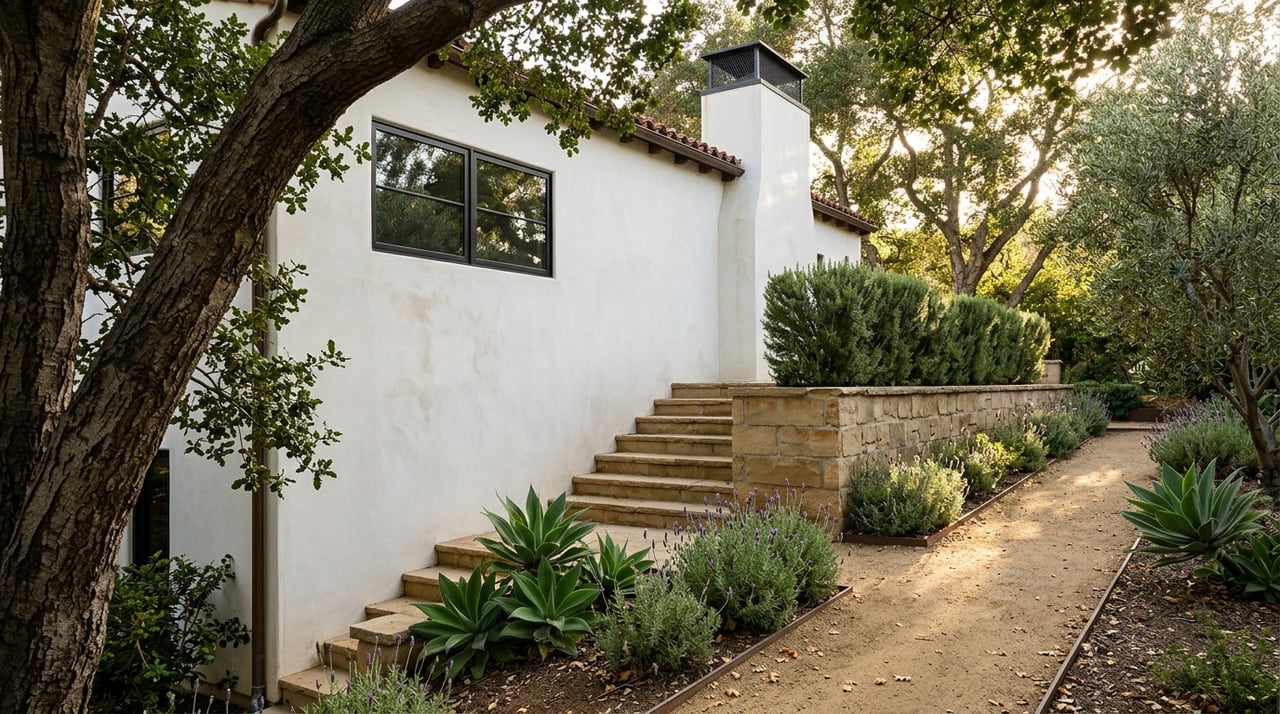
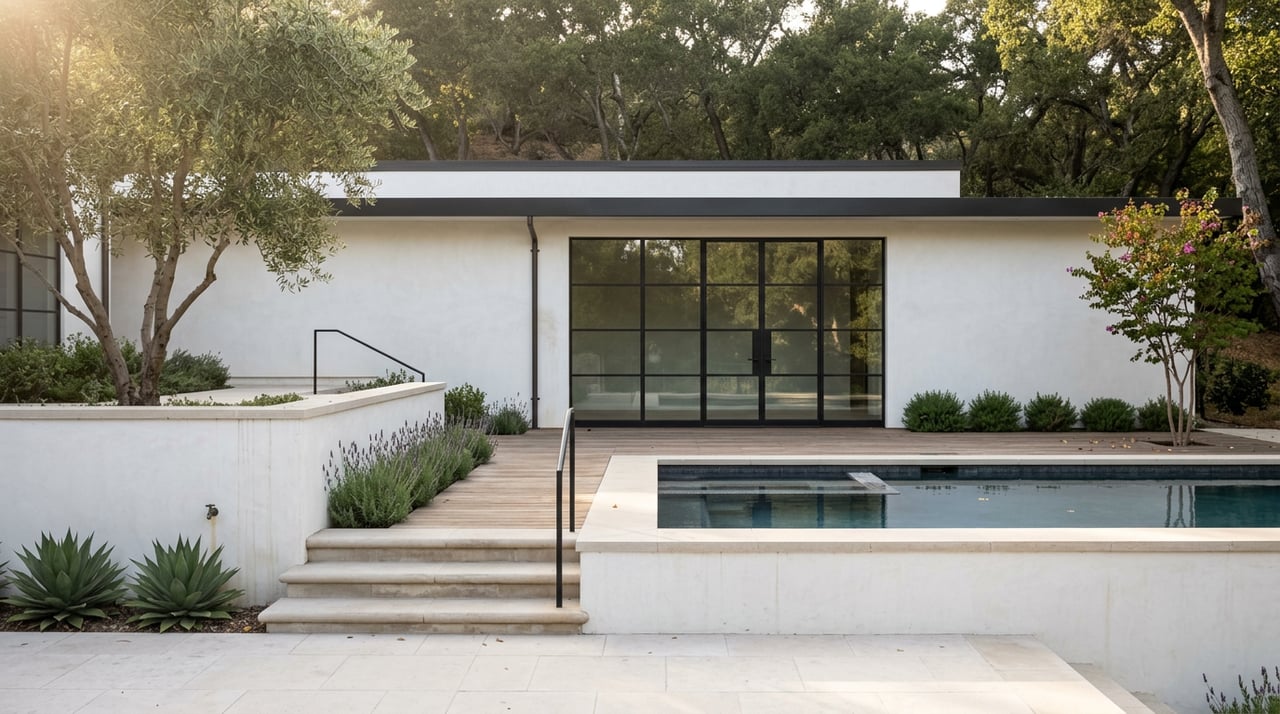
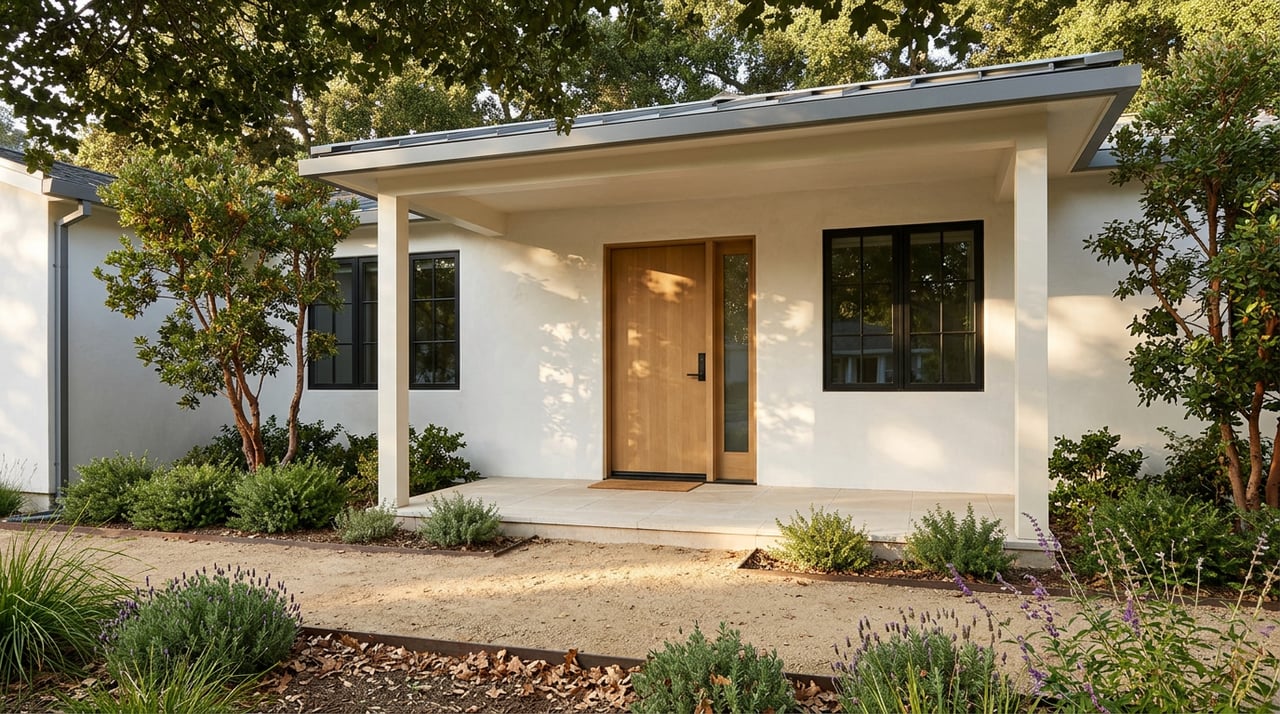
The Riviera as most people picture it today, red tile roofs, white stucco walls, oak-shaded switchbacks climbing between Mission and Sycamore Canyons, is largely the work of one developer in the 1910s. According to the Riviera Association's own history of the neighborhood, the man who platted the tract required buyers to build a tile-roofed, white stucco home for a minimum of $4,000, a serious sum during World War I. He planted hundreds of oak seedlings that have since grown into the gnarled trees many owners assume predate the subdivision entirely. He imported Italian stonemasons to quarry the field stone into the walls, gateposts, and stairsteps that still line the streets, work the Association itself calls close to a lost art today. He also oriented every lot so that no new house would block a neighbor's view of the harbor and islands.
And he insisted that utility wires and cables go underground.
That last rule never covered the whole ridge forever. It applied to the streets and lots inside his original tract, at a moment when a handful of poles could serve every household on the hill. Over the following century, the Riviera grew past those original boundaries, electrical demand multiplied many times over, and new circuits went in the way most of Southern California's grid went in: strung overhead, pole to pole, because that was faster and far cheaper than trenching through sandstone on a slope. The neighborhood's founding document and its actual infrastructure drifted apart long before anyone now living there bought a house here.
What happened in February moved the ridge in the opposite direction from its own original rule. Five more poles went up, by air, adding to exactly the kind of visible overhead line the man who platted these streets tried to ban before the first house was built. A century later, wildfire economics are pulling this hillside further from its founding promise, not closer to it.
It would be easy to assume that any wildfire-era utility work on a hillside like this ends with wires buried in the ground. That is not what happened in February, and understanding why says something about what residents should expect going forward.
Undergrounding is the more permanent fix, but it is also the expensive one. A rough industry figure puts the cost of burying one mile of line at around $3.8 million, compared with roughly $840,000 per mile for covered conductor, the insulated wire strung on poles that utilities increasingly use as a cheaper way to cut ignition risk in high fire areas. That is more than four times the cost for the same mile of grid.
In June 2026, the state's Office of Energy Infrastructure Safety approved a request from SCE to reduce its own systemwide undergrounding targets for 2026 through 2028 and lean more heavily on covered conductor instead, a shift tied directly to funding limits in its latest rate case. Statewide, the utility is now leaning away from the costlier option even as it works through a broader $6.2 billion, three-year wildfire mitigation plan. Against that backdrop, five new poles going up on the Riviera this February looks a lot less like a one-off and more like the version of grid hardening the state's own funding math currently favors almost everywhere, including on a ridge whose founding paperwork pointed in the opposite direction.
The helicopter itself is a separate story about terrain. The Riviera's streets are old, narrow, and steep enough that the city's own Safety Element already flags many of them as tighter than the current minimum standard, which is part of why fire apparatus access here draws scrutiny in the first place. Getting a truck-mounted crane up some of those blocks to set a pole is not always practical. Lifting the pole in by air and setting it in a matter of minutes, evacuation and all, is often the more realistic option on a hill like this one.
If you live on the ridge and you see more crews, more flagging, or more short-notice notices in the months ahead, more pole work, not trenching, is the more likely reason.
Part of why infrastructure work here draws so much attention is that there is so little else happening on these streets day to day. Grassy front lawns are rare on the Riviera, most homes are built to the edge of a steep lot, and the neighborhood has almost no retail of its own. Life here tends to happen behind garden walls and on private decks rather than out on the sidewalk, partly because there often isn't much of a sidewalk to begin with. The city's own pedestrian planning has identified the lack of sidewalks along Alameda Padre Serra as the main walkability gap in the neighborhood, and while the older paseo network helps residents cut between streets on foot, the hillside terrain limits how much more can realistically be added.
That makes the ridge's few public gathering spots do a lot of work. The SBIFF Riviera Theatre, at 2044 Alameda Padre Serra, has been the neighborhood's arthouse cinema since the Santa Barbara International Film Festival took over the lease in 2016 and reopened it the following year after a renovation. It still runs a full daily schedule. A few steps away, the Belmond El Encanto's ocean-facing terrace, part of a hotel property dating to the 1920s, serves everything from Sunday brunch with a jazz trio to evening cocktails with live piano, open to the public as well as hotel guests. At the western end of the ridge, an ornate 1916 Italian-style villa still stands as a private school campus, one of the few surviving mansions from the neighborhood's earliest wave of construction.
For open space, residents rely on Franceschi Park, built from the old arboretum of the Florentine horticulturist Francesco Franceschi, who bought 40 acres of Riviera hilltop land in 1904 to develop what became one of California's premier plant collections. When his estate later sold to a new owner in 1927, 14 of those acres were offered to the city for park purposes. The city did not actually accept the gift until 1931, after the newly formed Riviera Association agreed to guarantee two years of maintenance costs itself. There is also the smaller Loma Media Park, a pocket of open space that trades size for one more angle on the same panoramic view the whole ridge is known for. Between the theater, the terrace, and these two parks, that is close to the full list of places on the Riviera where you might run into a neighbor who doesn't live on your own street.
The Riviera Association, the homeowner group that has represented the neighborhood since it helped guarantee maintenance funding for Franceschi Park back in 1931, remains the clearest source of on-the-ground updates for residents. It has hosted Firewise information sessions where the county's Fire Safe Council walks homeowners through home hardening options and free evaluations, alongside city officials briefing residents directly on infrastructure plans.
One distinction worth keeping straight: SCE's wildfire-driven pole work on the Riviera is a separate effort from the City of Santa Barbara's own long-running Rule 20A undergrounding district program, which is currently underway a short distance away on Cliff Drive and funded through an entirely different pool of utility credits. If you hear about both projects this year, they are not the same one, and new poles on your own street say nothing about whether, or when, an actual undergrounding district might eventually reach the Riviera itself.
For a neighborhood whose founding paperwork tried to ban visible wires before the first house went up, watching new poles arrive by helicopter a century later is a reminder of how differently wildfire-era utility economics can cut against a neighborhood's original design intent, even in a place that thought it had already solved this problem.
If you already live on the Riviera and you are curious what any of this means down the road for a property here, from view corridors to fire hardening to what buyers ask about first, Caleb Overton has covered the buying side of this hillside separately, including the tradeoffs around access and upkeep that come with the terrain. And if a conversation ever turns from curiosity to a real decision about your home, Caleb is a familiar, local voice worth having in your corner. Request a Complimentary Home Valuation whenever that day comes.
Stay up to date on the latest real estate trends.

Etiam non quam lacus suspendisse faucibus interdum. Orci ac auctor augue mauris augue neque. Bibendum at varius vel pharetra. Viverra orci sagittis eu volutpat.