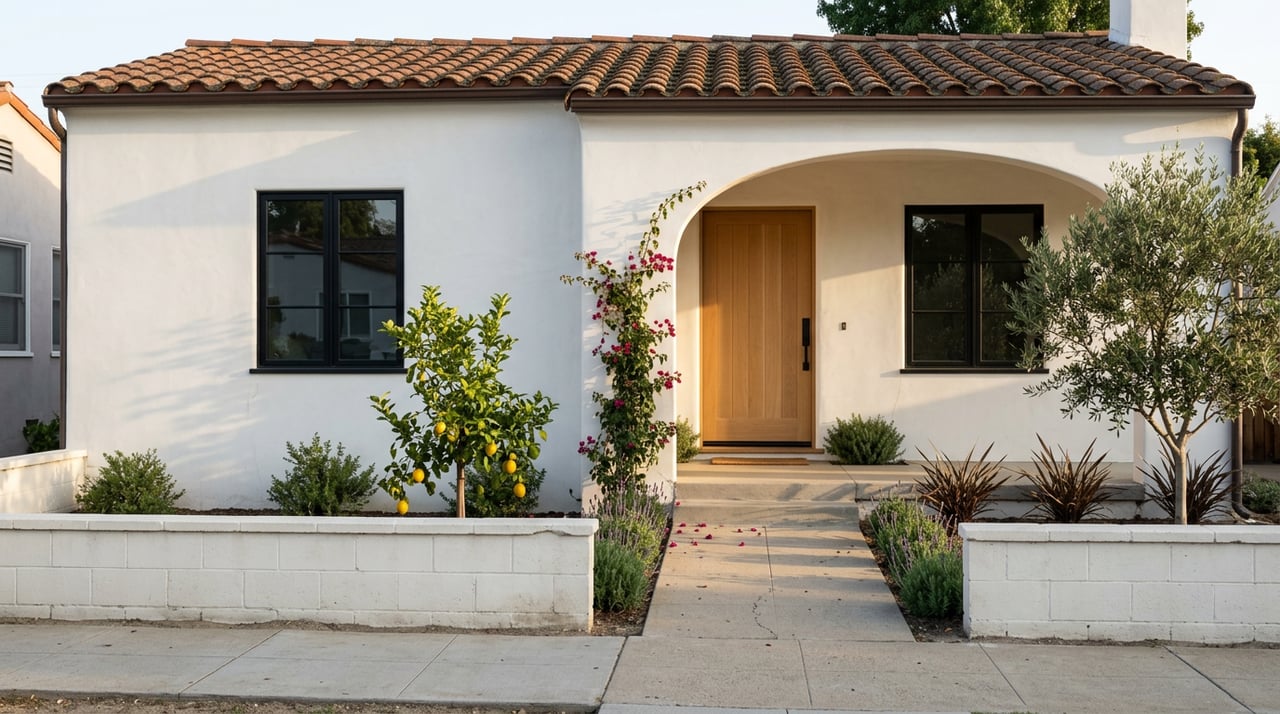
The Milpas Street Taco Bell Failed Its Own Landmark Test. It's Being Restored Anyway.
August 20, 2026
August 20, 2026
Drive past 821 N. Milpas St. right now and you'll find the windows dark and the drive-thru chained off. No sign explaining why, no banner promising a comeback. If you didn't already know the story, you'd assume another lease had quietly ended, the way they do all over that stretch of Milpas.
What's actually happening is stranger and better than that. This is one of the last Taco Bells in the country still standing in its original 1966 mission-style building, and it's closed for a renovation that Taco Bell itself has said will lean back into that original design rather than away from it. That's worth sitting with, because it runs against how these stories usually go. A chain restaurant doesn't typically get more faithful to its own history as it ages. This one is.
The Milpas location opened on January 28 and 29, 1966, four years after Glen Bell founded the chain in Downey. It wasn't a corporate rollout. A local schoolteacher named John K. Bishop called Bell directly, said he wanted to bring the franchise to Santa Barbara, and got a yes despite having zero restaurant experience. Six months later, Taco Bell was featuring Bishop in its own advertising as a model of what a franchise owner should look like. He ran the Milpas store until the late 1980s.
The opening itself was a production: a mariachi band, free beach hats, a clown named Jingles making balloon animals, and a searchlight pointed at the sky so people could find the place without needing the address. That's the kind of detail that only survives in local memory and old newspaper archives, and it's part of why this building means something beyond fast food.
The design holds up too. Original Taco Bells had a bell mounted on the roof, three open arches across the front, stucco walls, and a walk-up order window. Milpas still has most of that. It's one of only a handful of locations left in the country built that way and still operating as a Taco Bell.
In March 2025, Santa Barbara's Historic Landmarks Commission took up the question of whether the Milpas building deserved local "structure of merit" status. This is the kind of civic process that usually happens without anyone outside city hall noticing, but the vote here is worth knowing because of what it turned on.
The original 1966 building had three arches. At some point, a fourth was added to expand the dining room. That one arch, tacked on to fit more seating, is what tipped the commission's decision. Tim Hazeltine, the historic preservation consultant who prepared the resources report, called the building a rare surviving example of "programmatic architecture," meaning the design itself is doing marketing work, telling you what's being sold before you read a sign. He described the look as evoking a kind of stylized Spanish mission feel. But the fourth arch broke the original street facade, and that was enough. The commission voted 8-0 against landmark status.
Commissioner Dennis Doordan's comment from that hearing gets at the actual tension:
"Nostalgia is different than historical significance. Nostalgia, in my opinion, is not a reason to preserve."
Another commissioner, Michael Drury, reportedly asked whether anyone researching the building had turned up a photo of a family eating there every Friday night, which tells you the room wasn't unsympathetic to the building's pull. They just didn't think fondness was the same thing as historic integrity, and a modified facade doesn't get grandfathered in because people like it.
Here's the part that makes this more than a footnote in a city commission's minutes. Denied landmark status carries no legal protection and no requirement to preserve anything. A building in that position is, if anything, more exposed to being altered or torn down, not less. That's usually how these stories end for old commercial buildings on busy commercial corridors.
Instead, the franchise closed the Milpas location in late July 2026 for what's been reported as a three to four month renovation, and Taco Bell told SFGATE in 2025 that the point of the work is to draw inspiration from the 1966 design, not modernize past it. Whatever protection this building is getting isn't coming from a landmark plaque. It's coming from a corporate decision that the original look is worth the construction cost, made after the city already said no.
That's a genuinely unusual sequence. Most preservation, when it happens at all, happens because a government body compels it. Here the compulsion is coming from somewhere else: a company betting that a facade people already feel nostalgic about is worth more intact than modernized, even without anyone requiring it to stay that way.
The scarcity here isn't exaggerated. The very first Taco Bell, at 7112 Firestone Blvd. in Downey, closed in 2015 and the structure was physically relocated to Taco Bell's Irvine headquarters, where it's preserved as a company artifact rather than a working restaurant. A sister original-era location in Goleta, at 5980 Hollister Ave., also opened in 1966 and still operates, though it carries a stylized bell outline rather than an actual bell on the roof. Elsewhere in the country, the losses have kept coming: a 1966 location in Scottsdale, Arizona closed in April 2025, and a Lafayette, California store dating to around 1968 closed in January 2026. That Lafayette closure was the one that pushed the number down to where it sits today. What's left nationally, by the accounts tracking these buildings, is down to six original mission-style Taco Bells still doing business as Taco Bells, out of what was once thousands built this way.
Milpas Street isn't just one of those six. Multiple people who study this specific architectural niche have pointed to it as the oldest one still operating in its original structure, which means Santa Barbara is currently home to the best surviving example of a design era that's nearly extinct everywhere else, sitting on a stretch of Milpas most people drive past without a second look.
You don't need to care about fast food architecture to find something in this. The building on Milpas is a small, specific case study in how a place decides what's worth keeping. The city looked at genuine affection for a building, weighed it against a technical standard, and ruled against the building. The company that owns it looked at the same affection and decided to spend money reinforcing it anyway. Both readings of the same structure are legitimate, and the gap between them is the interesting part.
It's also a reminder that a neighborhood's character on a corridor like Milpas doesn't always survive because a commission voted to protect it. Sometimes it survives because enough people cared out loud, long enough, that a business decided the caring was worth building around. That's a quieter kind of preservation than a landmark designation, and it's easy to miss unless you're paying attention to the block.
If you're watching this stretch of Milpas for the reopening, expect it sometime in the fall based on the reported three to four month timeline from its late July closure. In the meantime, the boarded windows are worth a second look next time you're driving past. That building has outlasted almost every other one like it in the country, and it's about to look even more like it did in 1966, not because a commission said it had to, but because someone decided it should.
If you're the kind of person who notices details like a modified arch changing a building's fate, you probably think about your own home's history and condition the same way. That's the kind of read Caleb Overton brings to every property conversation in this city, whether it's a landmark question or just understanding what a home is really worth. If you're curious what that kind of attention could mean for your own place, request a complimentary home valuation and find out.
Stay up to date on the latest real estate trends.
Etiam non quam lacus suspendisse faucibus interdum. Orci ac auctor augue mauris augue neque. Bibendum at varius vel pharetra. Viverra orci sagittis eu volutpat.